

Reading market trends before taking a trade is one of the most important skills every trader must learn. Many beginners enter trades without understanding the direction of the market, which often leads to losses For beginners, this movement can look confusing and unpredictable. Many new traders make the mistake of entering a trade without understanding the overall market trend. This often leads to losses and frustration.
Successful traders know one important rule: always understand the market trend before taking a trade. Reading market trends helps traders identify the direction of the market and make better decisions. In this article, we will explain how to read market trends and how it can improve your trading results
What is a Market Trend?
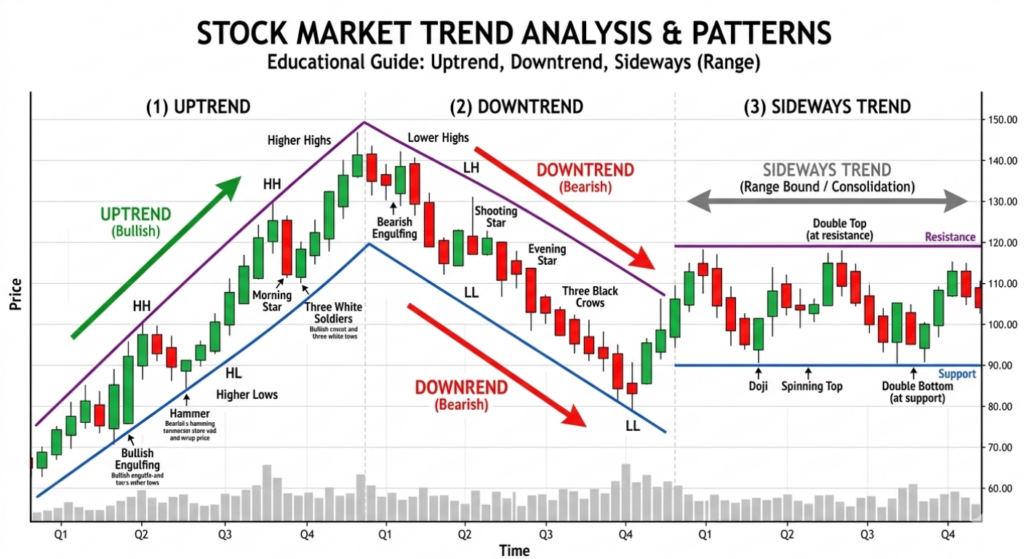
A market trend refers to the general direction in which the market or a stock price is moving over a period of time. There are three main types of trends in trading.
Uptrend:
An uptrend occurs when prices are continuously moving higher. In this trend, the market creates higher highs and higher lows. Traders usually look for buying opportunities during an uptrend.
Downtrend:
A downtrend happens when prices are moving lower over time. The market forms lower highs and lower lows. During a downtrend, traders often look for selling opportunities.
Sideways Trend:
Sometimes the market does not move strongly up or down. Instead, prices move within a range. This is called a sideways or consolidation trend.
Understanding which trend the market is currently following is the first step before placing any trade
Why Reading Market Trends is Important
Trading without analyzing the trend is like driving a car without knowing the direction. Many traders lose money because they try to trade against the trend.
Here are some reasons why trend analysis is important:
- It helps traders follow the direction of the market.
- It increases the probability of successful trades.
- It reduces emotional trading decisions.
- It improves risk management.
Professional traders often say, “The trend is your friend.” This means it is always safer to trade in the same direction as the market trend
Use Multiple Time Frames
One of the most effective ways to read market trends is by analyzing multiple time frames.
For example:
- Daily chart: Shows the overall long-term trend.
- Hourly chart: Helps identify medium-term movements.
- 5-minute or 15-minute chart: Used for entry and exit points.
By combining different time frames, traders can get a clearer picture of the market structure.
For instance, if the daily chart shows an uptrend and the shorter time frame gives a buying signal, the probability of a successful trade increases
Identify Support and Resistance Levels
Support and resistance levels are important tools for understanding market behavior.
Support is the price level where a stock usually stops falling and starts moving upward.
Resistance is the price level where the stock struggles to move higher.
When a stock breaks a strong resistance level, it may start a new upward trend. Similarly, when support breaks, the market may move downward.
Traders often combine trend analysis with support and resistance to find better trade opportunities
Use Moving Averages
Moving averages are one of the simplest and most popular indicators used by traders to identify trends.
A moving average calculates the average price of a stock over a certain period of time. Commonly used moving averages include:
- 20-day moving average
- 50-day moving average
- 200-day moving average
If the price stays above the moving average, it usually indicates an uptrend. If the price is below the moving average, it may indicate a downtrend.
Many traders also use moving average crossovers to identify trend changes
Watch Market Volume
Volume represents the number of shares being traded in the market. It helps traders understand the strength of a trend.
For example:
- If a stock is rising with high volume, it indicates strong buying interest.
- If prices rise but volume is low, the trend may not be strong.
- A sudden increase in volume can signal a possible breakout.
Volume analysis helps confirm whether the trend is reliable or weak.
Follow Market News and Sentiment
Market trends are also influenced by news, economic data, and investor sentiment. Important announcements like interest rate decisions, company earnings, or government policies can affect stock prices.
Traders often monitor:
- Economic reports
- Company earnings announcements
- Global market movements
- Investor sentiment
Understanding market sentiment helps traders anticipate potential trend changes
Avoid Trading Against the Trend
One of the most common mistakes beginners make is trying to predict reversals too early. They attempt to sell in an uptrend or buy in a downtrend hoping for a quick profit.
This strategy can be risky because strong trends often continue longer than expected. Instead of predicting reversals, traders should focus on following the trend and managing risk properly
Combine Trend Analysis with Risk Management
Even the best trend analysis cannot guarantee a successful trade every time. Therefore, risk management is essential.
Traders should always:
- Use stop-loss orders
- Avoid risking too much capital in a single trade
- Maintain a disciplined trading strategy
Combining trend analysis with proper risk management helps traders survive in the market for the long term
Final Thoughts
Reading market trends is one of the most important skills every trader must develop. Instead of making random trades, successful traders study price movements, identify the trend, and plan their trades carefully.
By using tools like multiple time frames, support and resistance levels, moving averages, and volume analysis, traders can gain a clearer understanding of the market.
Remember, trading is not about making quick profits every day. It is about making consistent and well-informed decisions over time. When traders learn to follow the market trend and manage risk effectively, their chances of success increase significantly
FOR A FREE STOCK MARKET SEMINAR VISIT HERE
CALLS @ 9986622277
Disclaimer
The information provided here is for general informational purposes only and should not be construed as financial advice. Investing in the stock market involves inherent risks, and there is no guarantee of profits or protection against losses. Before making any investment decisions, it is essential to conduct thorough research and seek advice from a qualified financial advisor or professional