
India’s financial markets are expanding rapidly, attracting new investors every year. Among the various indicators used to understand market behaviour, the Nifty 50 index is one of the most trusted. Whether someone checks indexnse nifty_50, follows Nifty today on mobile apps, or analyses a Nifty 50 chart, this benchmark provides a clear picture of how the broader market is performing.
This detailed guide explains its meaning, structure, components, and significance for Indian investors.

1. What Is the Nifty 50 Index?
The Nifty 50 is a benchmark index created by NSE Indices Limited. It represents 50 leading companies listed on the National Stock Exchange. These companies are chosen from various sectors, giving the index a broad and diversified structure.
The main goals of the index are:
- To represent the performance of India’s top corporations
- To help investors understand market sentiment
- To act as a benchmark for mutual funds, ETFs, and portfolio evaluation
Because the index includes the country’s largest companies, tracking Nifty today helps traders understand if the market is bullish, bearish, or neutral.

2. Historical Background
Launched in 1996, the Nifty 50 became one of the earliest scientific indicators of India’s equity market. Before its introduction, investors relied on various fragmented indicators. This index brought structure, clarity, and global standards to the Indian market.
Over the years, it has evolved by:
- Updating its composition
- Improving methodology
- Ensuring transparency
- Aligning with international index standards
Its continuous updates ensure that it remains relevant to India’s evolving economic landscape.

3. Eligibility Criteria for Index Inclusion
Not every large company can be included in the Nifty 50 index. NSE follows strict criteria to ensure quality representation.
Key rules include:
1. Minimum listing and trading track record
The stock must be listed on NSE for a specific duration and available in the derivatives segment.
2. High free-float market capitalization
Only shares available for public trading are considered.
3. Strong liquidity
The stock should have high trading volumes and low impact cost.
4. Sector representation
The index aims to cover the Indian economy holistically.
These rules ensure that only strong, reliable, and high-performing companies become part of the index.
4. Sector Representation in the Index
The Nifty 50 represents 13 major sectors, including:
- Banking & Financial Services
- Information Technology
- Oil & Gas
- Automobiles
- FMCG
- Telecom
- Metals
- Pharmaceuticals
- Cement
- Power
- Construction
- Conglomerates
- Consumer Services
This diversity helps the index remain stable even when individual sectors experience corrections.
5. Calculation Methodology
Understanding how the index is calculated helps investors read Nifty share price movements more effectively.
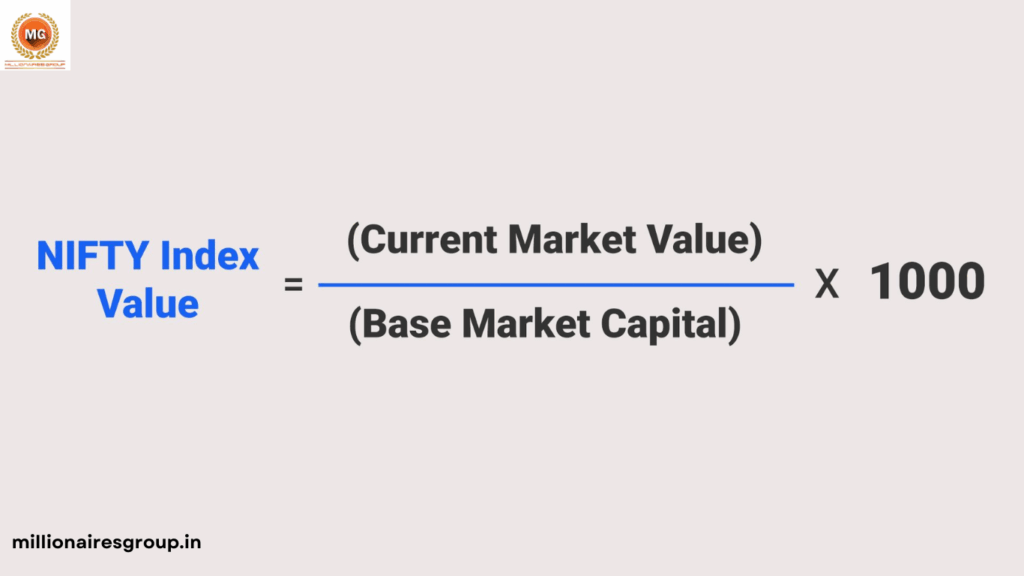
The index follows the free-float market capitalization weighted method.
Steps involved:
- Calculate each company’s total market value
- Apply the free-float factor
- Add the free-float market caps of all 50 companies
- Compare the total with the base market cap
- Multiply by the base value (1000)
Why is this method used?
It ensures that companies with higher public participation influence the index more than companies dominated by promoter holdings.
This is why large companies like Reliance Industries or top banks create major moves in the index.
6. Why the Nifty 50 Index Is Important
There are many reasons why the Nifty 50 is considered the heartbeat of the Indian stock market.
1. Most widely used benchmark
Mutual funds, ETFs, and PMS strategies compare their performance with this index.
2. Market sentiment indicator
If the index rises sharply, it signals strong investor confidence. If it falls significantly, it indicates caution or fear.
3. Reflects India’s economic health
Since it contains the country’s top companies, it mirrors the economy’s current condition.
4. Foundation of derivatives trading
Index futures and options based on this benchmark attract massive trading volumes daily.
5. Preferred tool for passive investors
Index funds based on this benchmark offer low-cost investment opportunities.

7. Understanding Nifty 50 Chart Movements
Many traders rely on a Nifty 50 chart to make informed decisions. It shows:
- Daily price movement
- Long-term trends
- Volume patterns
- Support and resistance levels
- Technical indicators
Popular tools used to analyse charts:
- Trendlines
- Moving averages (50-day, 200-day)
- MACD
- RSI
- Bollinger Bands
The chart helps both beginners and experts understand whether the market is trending upward, downward, or sideways.

8. Why Investors Track Nifty Share Price Daily
The nifty share price has a major influence on financial planning, mutual fund returns, and overall portfolio strategy.
Reasons investors track it:
A. Impact on equity mutual funds
If the index goes up, fund NAVs generally rise.
B. Tool for intraday trading
Many traders rely on index movement to plan trades in individual stocks.
C. Helps understand sector performance
A rising index often indicates bullishness across various sectors.
D. Useful for long-term investment planning
Investors use index trends to identify dips and accumulate units through SIPs or lump-sum investments.

9. Factors That Influence the Nifty 50 Index
Understanding what drives the index helps interpret the Nifty’s movement better today.
1. Global stock markets
Events in the US, Europe, and Asia have a direct effect on Indian markets.
2. Crude oil prices
High oil prices increase inflation and impact corporate profits.
3. Rupee-Dollar movement
A weaker rupee affects import-heavy sectors.
4. RBI interest rates
Monetary policy announcements influence investor sentiment.
5. Government policies
Union Budget, reforms, and regulations impact market behaviour.
6. FII and DII activity
Large buy or sell orders from institutions can move the index sharply.
7. Corporate earnings
Quarterly results from index constituents determine short-term momentum.
10. How Investors Use the Nifty 50 to Make Better Decisions
1. Portfolio benchmarking
Comparing your portfolio returns with the index helps evaluate performance.
2. Risk management
Derivatives based on the index help hedge market risk.
3. Sector analysis
Investors track index components to identify which sectors are gaining strength.
4. Entry and exit planning
Corrections in the index help long-term investors accumulate quality funds.
11. Should You Invest in Nifty 50-Based Funds?
Many experts recommend index-based investing for long-term wealth creation.
Benefits include:
- Low expense ratio
- High transparency
- Low risk compared to stock-picking
- Consistent performance
- Exposure to India’s biggest companies
For beginners who do not want to choose individual stocks, index funds based on the Nifty 50 provide a safe and dependable investment route.
Conclusion
The Nifty 50 is more than a number that fluctuates through the trading day. It represents the combined strength and performance of India’s leading companies. Tracking indexnse Nifty 50, following Nifty today, or studying a Nifty 50 chart gives investors a clear picture of market momentum and economic direction.
For traders, it’s a tool to understand volatility.
For long-term investors, it’s a benchmark for wealth creation.
For analysts, it’s a reflection of India’s economic pulse.
FOR A FREE STOCK MARKET SEMINAR, VISIT HERE
CALLS @ 9986622277
Disclaimer
The information provided here is for general informational purposes only and should not be construed as financial advice. Investing in the stock market involves inherent risks, and there is no guarantee of profits or protection against losses. Before making any investment decisions, it is essential to conduct thorough research and seek advice from a qualified financial advisor or professional.