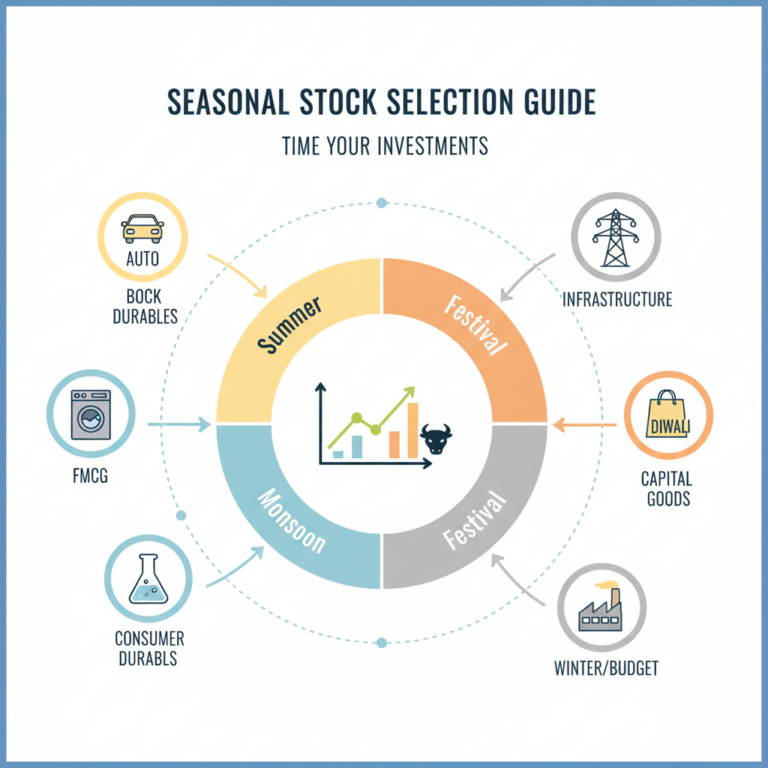
Many investors observe that certain sectors tend to perform differently during various times of the year due to economic cycles, festivals, earnings seasons, and global factors. This article explains how season-wise stock analysis works, what to observe, and the risks involved.
in this blog, you will definitely understand:
What season-wise stock selection means
Why seasons affect stock prices
Which sectors perform better in which season
How to select stocks step by step
Common mistakes to avoid
Disclaimer:
Stock market investments are subject to market risks. Seasonal trends are based on historical observations and do not guarantee future performance. This content is for educational purposes only and should not be considered financial advice
What is Season-wise Stock Selection?
Season-wise stock selection refers to stock selection based on the effect of the various seasons on business performance and price of stocks.
Every business has a cycle. Certain companies make higher incomes in certain months because:
Higher demand
Festivals
Weather conditions
Government policies
Budget announcement
Improvement in the earnings of the company boosts the confidence of the investors and the stock prices tend to increase.
For example:
Companies dealing with cooling and power do better during the summer.
The FMCG companies and retail companies do well during festivals.
The stocks related to agriculture are greatly dependent on the monsoon.
Knowledge of such cycles enables traders to make better decisions rather than to make random trades.
Why Seasons Affect the Stock Market
Seasons affect the stock market because business activity and consumer behavior change throughout the year.
Change in Consumer Demand
During festivals, people spend more money. In summer, demand for electricity, beverages, and travel increases. In monsoon, rural consumption becomes important.
Business Performance Cycles
Most companies report results quarterly. Certain quarters consistently show better performance due to seasonal demand.
Government and Economic Events
Events like the Union Budget, policy announcements, and elections also create seasonal trends in the stock market.
Because of these factors, season-wise stock selection helps traders align their trades with real economic activity.
Major Seasons in the Indian Stock Market
Budget Season (January – February)
The Indian stock market has one of the most significant times of the year between January and February; the so-called Budget Season during which traders and investors are engaged.
With this market, market activity is largely propelled by:
Government policy expectations
Union Budget announcements
The incentives and reforms that are sector-specific
The volatility will be increasing in this season and hence most traders who are smart, will be placing their positions before the actual budget is presented. It is possible to plan in advance.
Industries That Tend to Do Well in the Budgetary Season
Government spending arrangements and policy declarations tend to favor some industries:
Infrastructure – New projects and investments can increase growth.
Railways – These stocks are usually assisted by government spending.
Capital Goods – More demand in the industrial equipment and machinery.
PSU Stocks – The companies of the government sector tend to respond to incentives, which are driven by budgets.
Targeting these industries in the Budget Season may enable traders and investors to seize seasonal market opportunities and those initiated by the government.
2. Summer Season (March – June)
Summer Season (March – June)
During summer:
Electricity consumption increases
Travel and tourism rise
Demand for cooling products grows
Strong sectors during this period:
Power sector
Beverages
Travel and tourism
Consumer durables
This season offers good opportunities for season-wise stock selection if planned early.
Monsoon Season (July – September)
Monsoon plays a big role in the Indian economy.
Key impact areas:
Agriculture
Rural income
FMCG demand
Sectors that benefit:
FMCG
Fertilizers
Tractor and agro-related companies
Good monsoon news often creates positive market sentiment.
Festival Season (October – November)
This is the most important consumption-driven season in India.
High demand for:
Automobiles
Jewellery
Electronics
Retail products
Stock prices usually start moving before the festivals, which is why early planning is crucial.
Year-End and Results Season (December)
This period includes:
Quarterly results
Portfolio rebalancing
Tax planning
Sectors like banking and IT often show volatility due to institutional activity.
The concepts discussed in this blog aim to help readers better understand seasonal market behaviour and should be used only as a learning reference
Step-by-Step Process for Season-wise Stock Selection
Now let us understand how to apply this strategy practically.
Step 1: Identify the Current or Upcoming Season
Always ask:
Which season is coming next?
What events are expected?
Which sectors will benefit?
Successful traders plan one to two months in advance, not after the trend starts.
Step 2: Identify Benefiting Sectors
Once the season is identified, focus on sectors that historically perform well during that period.
For example:
Festival season → Auto and retail
Summer season → Power and travel
Monsoon season → FMCG and agriculture
This step filters out unnecessary stocks and keeps your focus clear.
Step 3: Shortlist Quality Stocks from the Sector
Not every stock in a strong sector is worth buying.
Choose companies with:
Consistent earnings
Strong market presence
Stable management
Clean balance sheet
Avoid weak companies even if the season supports the sector.
Step 4: Check Past Seasonal Performance
Go to stock charts and analyze:
How did the stock perform in the same season last year?
Does it show repeated seasonal rallies?
Is there an increase in volume during this period?
Stocks that show repeated seasonal strength are ideal for season-wise stock selection.
Step 5: Use Basic Technical Analysis
You don’t need advanced indicators.
Focus on:
Support and resistance
Trend lines
Moving averages
Volume confirmation
Buy only when price action supports your seasonal view.
Step 6: Decide Entry, Target, and Stop Loss
Never enter a trade without a plan.
Before buying:
Fix your entry price
Set a realistic target
Place a stop loss
Even the best seasonal strategy can fail without proper risk management.
Real-Life Examples of Season-wise Stock Selection
Festival Season Example
During festivals:
Auto companies see higher vehicle sales
Jewellery demand increases
Retail spending rises
Smart traders enter these stocks before the festive excitement starts.
Monsoon Season Example
Good monsoon:
Improves rural income
Increases FMCG sales
Boosts fertilizer demand
Stocks related to these sectors often react positively to monsoon forecasts.
Budget Season Example
Before the budget:
Infrastructure and PSU stocks become active
Market volatility increases
Traders with a clear plan can benefit from these movements.
Common Mistakes to Avoid
Entering Too Late
Most beginners buy when news is already everywhere. Professionals enter early.
Ignoring Fundamentals
A bad company will not perform well just because the season is favorable.
No Exit Plan
Always know when to exit, even if the trend looks strong.
Avoiding these mistakes improves consistency.
Advantages of Season-wise Stock Selection
Easy to understand
Based on real business performance
Improves trade timing
Reduces emotional decisions
Works for both traders and investors
This strategy brings structure and clarity to stock market decision-making.
Who Should Use This Strategy?
Beginners learning stock selection
Swing traders
Positional traders
Long-term investors
Anyone who wants to trade with logic instead of guesswork can benefit from season-wise stock selection.
Conclusion
Stock market success is not about tips or luck. It is about understanding patterns, timing, and discipline.
Season-wise stock selection helps you:
Observe sector trends linked to business cycles
Plan trades with better market awareness
Improve decision-making by avoiding impulsive trades
The concepts discussed in this blog aim to help readers better understand seasonal market behaviour and should be used only as a learning reference.